Shamrock Leopard SVG: St. Patrick’s Day Style, Not Just a Trend
As someone who’s stitched over 300 holiday-themed embroidery projects—from boutique baby onesies to Etsy best-selling aprons—I opened Shamrock Leopard Svg, St Patricks Day Svg expecting either charming whimsy or visual clutter. What I found was something more useful: a confident, balanced fusion of tradition and edge that actually translates well to thread.
I tested it first on a natural linen tea towel for a local gift shop’s March launch—no flashy mockups, just real fabric, standard 70-weight polyester thread, and my Brother PR680W. The design landed cleanly: the shamrock’s outline held crispness in satin stitch, while the leopard spots added playful texture without overwhelming the shape. It didn’t scream “clipart.” It whispered “handmade with intention.” That distinction matters—especially when your customer is choosing between your embroidered tote bag and a mass-produced alternative.
A Design That Breathes on Fabric
Shamrock Leopard Svg, St Patricks Day Svg works because it respects negative space. The clover leaf isn’t filled top-to-bottom; its three lobes are open, airy, and slightly asymmetrical—giving the eye room to land. That’s critical for embroidery. Dense fill-stitch clovers often puddle on cotton twill or bleed on lightweight knits. Here, the leopard patterning is applied selectively—not as an all-over texture, but as rhythmic accents inside each lobe and along the stem. That means fewer stitches, less stabilizer dependency, and better drape on garments like sweatshirts or baby bodysuits.
I ran it on a 100% cotton unisex crewneck. At 3.2” wide (my go-to size for chest placement), the spots remained legible—not fuzzy, not lost in the knit. No re-hooping needed. On a curved surface like a structured cap? I’d scale it down to 2.5” and add light tear-away stabilizer beneath the front panel. It’s not inherently cap-optimized, but it adapts—unlike many “holiday SVGs” that collapse at anything under 4”.
Where It Shines—and Where to Pause
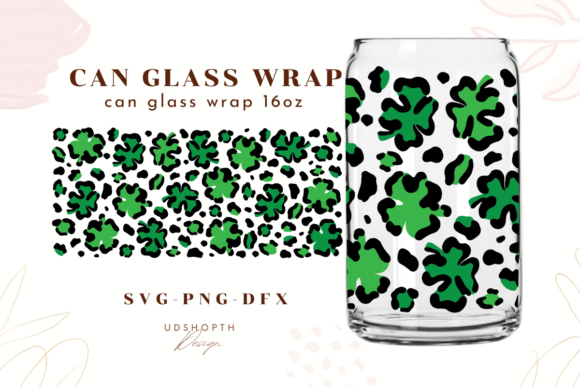
This isn’t a one-size-fits-all embroidery file. Its strength lies in medium-scale applications: pillow covers, kitchen towels, woven patch backings, and coffee sleeve wraps (yes—even though it’s labeled for Libbey 16oz glass wraps, the motif scales beautifully to insulated tumblers). As a machine embroidery design, it holds up across fabric textures: stable wovens, midweight fleece, even terry cloth—provided you use cutaway stabilizer for the latter.
But here’s where practical judgment kicks in:
- Thin or stretchy fabrics? Avoid full-size use on jersey or rayon challis without basting + topping. The spot detail can distort if the base shifts.
- Dark backgrounds? Test thread contrast early. Emerald green thread pops on cream, but charcoal grey spots vanish on black fabric unless you switch to metallic or white topstitching.
- Tiny hoops? Below 3”, the inner leopard markings soften. For 2” hoop embroidery (think keychain patches or baby hat fronts), simplify: stitch only the shamrock outline + one central spot.
- Frequent washing? The satin-stitched edges are tight enough for gentle cycles—but skip bleach and high-heat drying. This isn’t a logo built for industrial laundries.
What It Says About Your Brand—Before a Single Stitch
Your customers don’t read licensing fine print—they read *vibe*. When Shamrock Leopard Svg, St Patricks Day Svg appears on a handmade apron sold at a farmers’ market, it signals playfulness with polish. It tells buyers you understand modern craft: honoring tradition (the clover) without cliché (no leprechauns, no rainbows, no glitter fonts). That builds trust—especially for Etsy sellers and small shop owners curating cohesive seasonal collections.
I used it as an embroidered patch on denim jackets for a pop-up shop. Paired with neutral thread and raw-edge backing, it elevated the item from “cute accessory” to “thoughtful collectible.” Same design, different execution—proof that this SVG isn’t just graphics; it’s flexible design assets.
Real Designer Notes—No Fluff, Just Action
Before you load Shamrock Leopard Svg, St Patricks Day Svg into your embroidery software or list it in your digital shop:
- Test on scrap first—especially if stitching on textured weaves or dark fabrics. Spot density changes how light reflects off thread.
- Check stitch density in your editing software. If it exceeds 12,000 stitches, consider simplifying interior spots for baby items or lightweight apparel.
- Confirm hoop compatibility. It fits standard 4x4 and 5x7 hoops at recommended sizes—but verify alignment in your machine’s preview mode.
- Review small details: the stem taper, spot spacing, and outer edge smoothness. Jagged vectors won’t stitch cleanly, no matter how pretty the PNG looks.
- Mock it in black and white—not just color. If value contrast disappears, adjust thread shades before finalizing.
- Stabilizer choice matters: cutaway for knits, tear-away for stable wovens, fusible for lightweight linens.
- Licensing clarity is non-negotiable. Since this is listed as a Graphics product for Crafts, confirm whether commercial use (e.g., selling embroidered finished products or reselling the SVG) is permitted. Don’t assume.
Ultimately, Shamrock Leopard Svg, St Patricks Day Svg earns its place in a working designer’s library—not because it’s trendy, but because it stitches true. It bridges holiday relevance and year-round versatility. Whether you’re prepping custom apparel for a St. Paddy’s pub crawl, designing personalized gifts for a boutique, or building digital embroidery files for your Etsy shop, this design doesn’t ask you to work around it. It works with you.
And in the world of handmade product, that’s the quiet mark of a good embroidery file.